 By Akita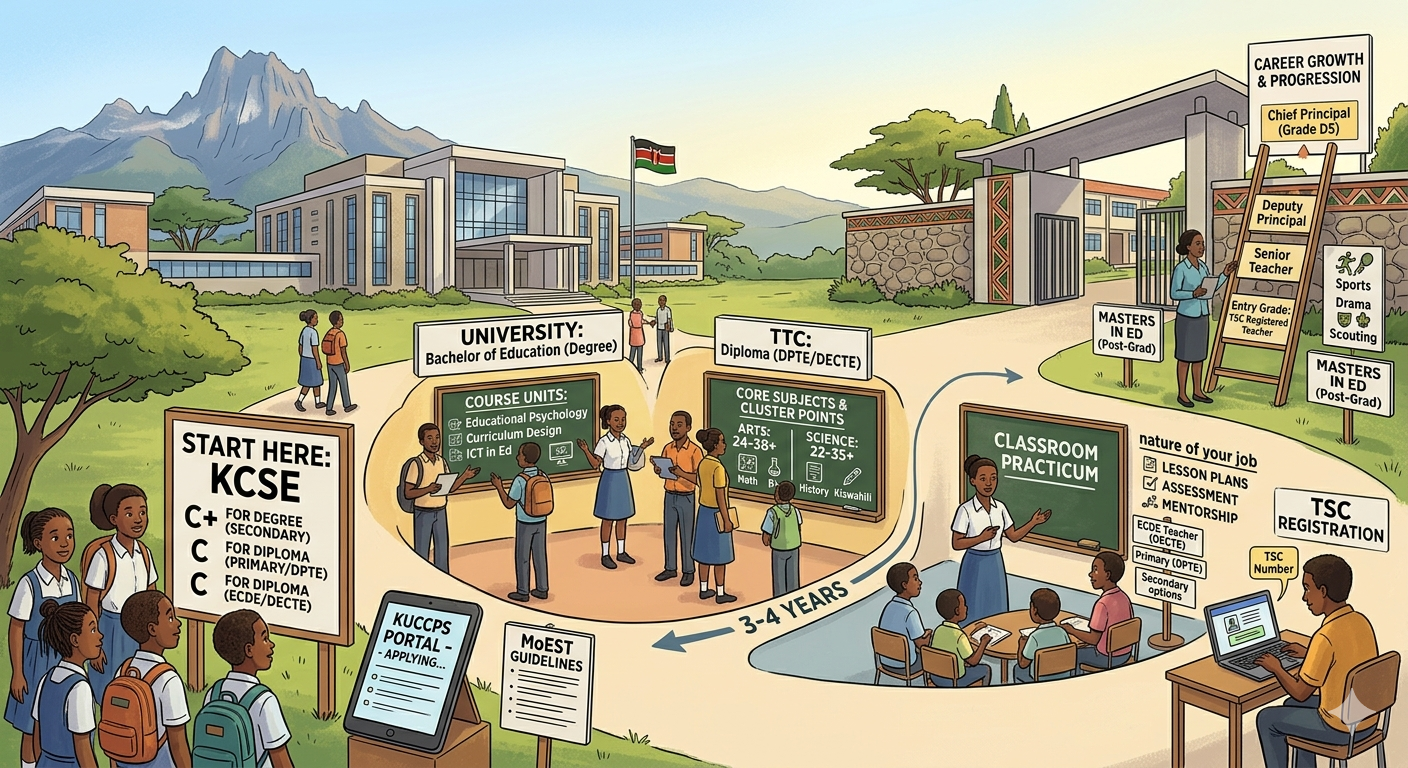
Your Guide to Becoming a Teacher in Kenya (2026 Edition)
Congratulations on considering a career in education! Teaching in Kenya is a dynamic and respected profession that has evolved significantly. With the full integration of the Competency-Based Curriculum (CBC), the training landscape is different today than it was a few years ago.
This guide is your complete roadmap, designed specifically for students preparing to join teacher training colleges (TTCs) or universities. Let’s break down exactly what you need to know.
Understanding the Big Shift: Goodbye P1, Hello Diploma
If you are just starting your journey, the most crucial update is that the old ‘P1 Certificate’ (Certificate in Primary Education) has been completely phased out for new trainees. As of 2026, Diploma-level training is now the minimum entry requirement for Early Childhood and Primary education.
The goal is to equip all new teachers with a deeper understanding of CBC methodologies, assessment strategies, and digital literacy.
Planning a career in teaching? Discover the 2026 requirements for DPTE, DECTE, and Degree programs in Kenya. Learn about KUCCPS cluster points, TSC registration, and how to apply.
1. Qualifications: Where Do You Start?
Your KCSE (Kenya Certificate of Secondary Education) results are your gatekeeper. The entry requirements differ based on the level you want to teach. The Teachers Service Commission (TSC) sets these standards.
| Level | Minimum KCSE Requirement | Path | What You’ll Teach |
| ECDE (DECTE) | Mean Grade C (Plain) | Diploma in Early Childhood Teacher Education | Pre-Primary (PP1 & PP2) |
| Primary (DPTE) | Mean Grade C (Plain) | Diploma in Primary Teacher Education | Grade 1 to Grade 6 |
| Secondary (Diploma) | Mean Grade C+ | Diploma in Secondary Teacher Education | Junior & Senior Secondary (Grades 7–12) |
| Secondary (Degree) | Mean Grade C+ | Bachelor of Education (Arts/Science) | Junior & Senior Secondary (Grades 7–12) |
A Note on Subject-Specific Entry Requirements:
- For DPTE (Primary): In addition to the C Plain mean grade, you must have scored at least a C (Plain) in English, Kiswahili, Mathematics, and at least one Humanity (e.g., History) or Science (e.g., Biology).
- For Secondary (Diploma/Degree): You must have scored at least a C+ in the two subjects you intend to specialize in (your ‘Teaching Subjects’).
2. Core Subjects and Cluster Points (University/Degree)
When applying for a Bachelor of Education degree through the KUCCPS Portal, you aren’t just ranked by your mean grade. KUCCPS calculates “Cluster Points” based on four key subject groups. A competitive cluster score is essential for admission to top public universities.
The university will review your performance in:
- Cluster 1: English or Kiswahili
- Cluster 2: Mathematics, Biology, Chemistry, Physics, or General Science
- Cluster 3: Geography, History, CRE/IRE/HRE
- Cluster 4: Any other subject from the groups above or a technical subject.
A Competitive Guide to Cluster Points (Bachelor of Education):
While cut-offs shift annually, you generally need to be competitive in these ranges for public university placement:
- Education (Arts): approx. 24 to 38+ points
- Education (Science): approx. 22 to 35+ points
Check the current KUCCPS portal during the application window for exact cut-offs from previous years.
3. Course Units: What You Will Study
Teacher training is a blend of mastering what to teach and how to teach it. Your course will be divided into two main areas:
Professional Units (Common to All Teachers)
These are essential education foundations that everyone must study:
- Educational Psychology: Learning how students think, behave, and develop.
- Curriculum Studies: Understanding CBC designs, how to plan lessons, and how to assess learners.
- Educational Technology & ICT: Using digital tools to enhance teaching.
- Philosophy of Education: Understanding the ‘why’ behind the methods.
- Sociology of Education: The role of the school within the wider Kenyan society.
Teaching Practicum (The Big Test)
This is not a unit in a classroom, but a full-term placement in a real school environment. During your Teaching Practice (TP), usually lasting 3 months, you will be assigned a mentor teacher and evaluated by your university/college supervisors while you actually teach lessons.
4. Colleges and Universities: Where Can I Train?
You can apply through the KUCCPS Portal when placements are open.
- Public Universities (Known for Degree Programs): Kenyatta University (KU), University of Nairobi (UoN), Moi, Egerton, and Maseno are traditionally strong education centers.
- Teacher Training Colleges (TTCs – The Diploma Pathway): For DPTE and DECTE, look for recognized TTCs such as Kaimosi, Machakos, Thogoto, Murang’a, and Migori TTC.
- Private Options: Mount Kenya University (MKU), Zetech University, and Strathmore University offer competitive and modernized education programs.
5. The Nature of the Job and Career Progression
Once you graduate, you cannot just walk into a classroom. You must first register with the Teachers Service Commission (TSC). Only registered teachers can be legally employed. Once you have your TSC number, your career journey begins.
Entry Grade
- Degree Holders: Typically start at Job Group C2 (Secondary Teacher II).
- Diploma Holders: Typically start at Job Group C1.
Your Daily Role (In a CBC Environment)
The nature of the job has moved away from lecture-style teaching. A modern Kenyan teacher is a facilitator. You will be responsible for:
- Developing lesson plans that encourage learner engagement and critical thinking.
- Assessing learners using rubrics and projects, not just written tests.
- Developing core competencies in your students, such as citizenship, communication, and digital literacy.
- Running co-curricular activities (sports, music, drama, scouting).
Career Growth
Teaching offers a clear career ladder:
- Teacher
- Senior Teacher
- Deputy Headteacher
- Headteacher/Principal
- Chief Principal (Grade D5) (The highest rank)
Post-graduate education is vital here. A Master of Education (M.Ed) is often a requirement or a major advantage when competing for administrative promotions or specialized roles in planning and curriculum development.
Your Final Checklist
- [x] Check your KCSE grades against the entry requirements.
- [x] Review the KUCCPS portal for cluster points and application dates.
- [x] Choose your teaching subject combination (Secondary) carefully based on your interests and grades.
- [x] Apply to accredited universities/TTCs.
- [x] Prepare for a rewarding, dynamic, and essential career.
