 By Elimu Assistant Team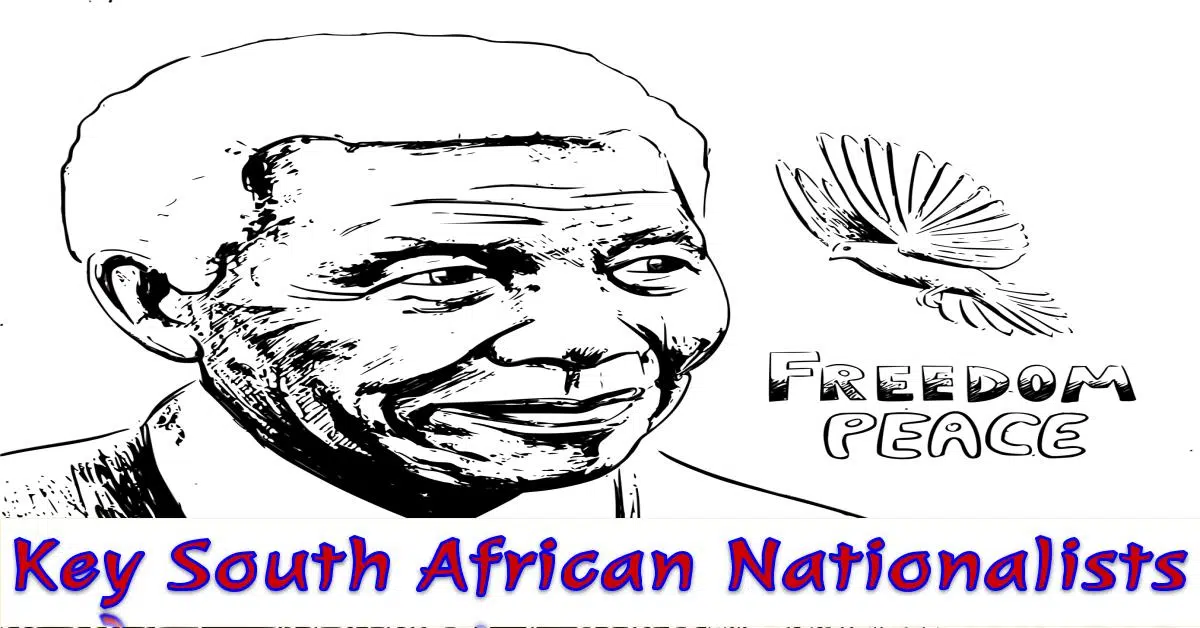
🧭 Table of Contents
- Key Nationalist Leaders (Nelson Mandela, Robert Sobukwe, Albert Luthuli)
- Methods of Struggle 🪧
- Challenges & Problems ⚠️
Key South African Nationalists
1. Key Figures of South African Nationalism
Nelson Mandela 🇿🇦 ✊🏾
“The Father of the Nation”
- Early Life & Education: Born Rolihlahla Mandela on July 18, 1918, into the Thembu royal family in Mvezo, Transkei. He received the name “Nelson” at a Methodist school. After his father’s death, he was raised by a regent. He attended Clarkebury Boarding Institute and later Fort Hare University, where he met lifelong friend Oliver Tambo. He was expelled for participating in a student protest.
- Political Awakening: Moving to Johannesburg, he met Walter Sisulu and became involved with the African National Congress (ANC), co-founding its militant Youth League. He led the 1952 Defiance Campaign against apartheid laws.
- Armed Struggle & Imprisonment: After the Sharpeville Massacre (1960), he concluded that peaceful protest was futile. He became the first leader of the ANC’s armed wing, Umkhonto we Sizwe (Spear of the Nation), coordinating sabotage campaigns. He was arrested in 1962 and, following the Rivonia Trial (1963-1964), was sentenced to life imprisonment.
- 27 Years in Prison: Incarcerated on Robben Island (18 years), Pollsmoor Prison, and finally Victor Verster Prison. His imprisonment became a powerful international symbol of the anti-apartheid struggle.
- Release & Presidency: He was released on February 11, 1990, and led the ANC in negotiations to end apartheid. He and State President F.W. de Klerk were jointly awarded the Nobel Peace Prize in 1993. In 1994, he was elected South Africa’s first black president in the first fully democratic election.
- Later Life & Legacy: He served one term (1994-1999), presiding over the transition to majority rule. He passed away on December 5, 2013, after a prolonged illness.
Robert Mangaliso Sobukwe 🖤🟢🟡
“The PAC Pioneer”
- Early Life & Education: Born December 5, 1924, in Graaff-Reinet. He attended Healdtown and Fort Hare University, where he joined the ANC Youth League and was elected president of the Student’s Representative Council.
- Africanist Ideology: A teacher and later lecturer, he became a leading Africanist within the ANC, criticizing its multi-racial approach. He believed liberation must be driven solely by Africans. He left the ANC to form the Pan Africanist Congress (PAC) in 1959, becoming its first president.
- Anti-Pass Protest & imprisonment: On March 21, 1960, he led the PAC’s non-violent anti-pass law protest, presenting himself for arrest at Orlando Police Station. This preceded the Sharpeville Massacre the same day. Sobukwe was convicted of incitement and imprisoned for 3 years. Under a unique “Sobukwe Clause,” his detention was renewed annually, and he was kept in solitary confinement on Robben Island for six more years.
- Later Life: Released in 1969, he was placed under strict house arrest in Kimberley until his death from lung cancer on February 27, 1978.
Albert Luthuli ☮️
“The Peaceful President”
- Early Life & Leadership: Born circa 1898 in Rhodesia to a missionary family, he was raised by his uncle in Groutville, Natal. He worked as a teacher and lay preacher before being elected Chief of the Groutville community in 1936.
- ANC Leadership: He joined the ANC in 1944 and was elected President-General in 1952. The government immediately forced him to choose between his chieftaincy and the ANC; he refused to resign from the ANC and was deposed as chief.
- Philosophy & Recognition: A devout Christian, he was a firm advocate of non-violent resistance. For his leadership in the struggle, he was awarded the 1960 Nobel Peace Prize.
- Publications & Death: He authored the autobiography Let My People Go (1962). He died on July 21, 1967, after being struck by a train near his home.
2. 🪧 Methods of Liberation Struggle
Nationalists employed a diverse range of tactics to dismantle white minority rule:
- 📢 Mass Media & Communication: Used newspapers (e.g., The Africanist), pamphlets, and radio to articulate grievances, spread propaganda, and mobilize mass support.
- ✊ Mass Action & Civil Disobedience: Organized defiance campaigns, demonstrations, strikes, and boycotts to disrupt the economy and provoke the state.
- 🧨 Armed Struggle & Sabotage: After the banning of peaceful parties, formed armed wings (e.g., Umkhonto we Sizwe). Guerrilla fighters trained abroad carried out sabotage against strategic military and economic installations.
- 🗣️ International Diplomacy & Lobbying: Sent petitions and delegations to global forums (e.g., the UN) to isolate the apartheid regime and build international pressure through sanctions and disinvestment campaigns.
- 🤝 Negotiation: Engaged in protracted multi-party negotiations to transition power to the majority, culminating in the 1994 elections.
- ⚖️ Moral & Religious Condemnation: Leaders like Archbishop Desmond Tutu campaigned globally, framing apartheid as a moral evil.
- 🧠 Ideological Movements: Groups like Steve Biko’s Black Consciousness Movement worked to psychologically liberate Black people from inferiority complexes imposed by apartheid.
- 📜 Unifying Documents: Created manifestos like the Freedom Charter (1955), which proclaimed a vision for a non-racial, democratic South Africa.
3. ⚠️ Challenges & Problems Encountered
The path to liberation was fraught with severe obstacles:
- 🚫 Political Repression: The government banned political organizations (ANC, PAC), effectively outlawing them and forcing them underground or into exile.
- 🔄 Exile & Detention: Key leaders were arrested, detained without trial, imprisoned for decades (Mandela, Sisulu), or forced into exile (Tambo), crippling organizational capacity.
- 💔 State Violence & Brutality: Security forces unleashed extreme violence, including the Sharpeville Massacre (1960) and Soweto Uprising (1976), and the torture and murder of activists like Steve Biko.
- 🎯 Divide and Rule Tactics: The regime created Bantustans (black homelands) to fracture African unity and fuel ethnic tensions, notably the conflict between the ANC and the Inkatha Freedom Party (IFP).
- 📵 Media Censorship: Nationalist voices were silenced through the banning of newspapers, censorship, and state control of radio, which was used for anti-nationalist propaganda.
- 🚷 Restrictive Legislation: Laws like the Pass Laws severely restricted the movement of Black people, while emergency regulations gave police sweeping powers to arrest and harass activists.
- 💸 Financial Constraints: A severe lack of funding and resources hampered the ability to organize, publish, and sustain the movement.
- ⚖️ Union Suppression: Trade unions were banned or heavily monitored, removing a key platform for mobilization and protest.
